
As cyber threats evolve, integrating artificial intelligence into cybersecurity development emerges as a crucial strategy. This integration promises to enhance threat detection, improve response times, and reduce the overall risk landscape across various sectors. Understanding the capabilities and limitations of AI in this space is essential for engineers and clinicians who seek to bolster their cybersecurity strategies effectively.
AI Algorithms: The Backbone of Cyber Threat Detection
Artificial Intelligence (AI) is increasingly pivotal within cybersecurity, functioning as the foundation for advanced threat detection systems. Among various AI techniques, supervised learning, unsupervised learning, and reinforcement learning stand out as key players. Each possesses unique attributes that significantly contribute to identifying and mitigating cyber threats.
Supervised Learning
This algorithm paradigm relies on labeled datasets to train models, making it incredibly effective for classification tasks. In cybersecurity, supervised learning algorithms can identify known threats by recognizing patterns in network traffic or user access logs. A simple example is spam detection where models are trained on labeled datasets of spam and non-spam communication. The learned patterns are then used to flag potential threats in real environments.
Engineers have harnessed supervised learning to create intrusion detection systems (IDS). By training on attack signatures and normal activity patterns, these systems can differentiate malicious attempts from legitimate activity. The decision tree algorithm is a popular choice for this application due to its ability to handle categorical data adeptly.
Unsupervised Learning
Unlike supervised learning, unsupervised learning does not rely on labeled datasets. It seeks to identify hidden patterns in data, making it particularly adept at anomaly detection. Anomaly detection is crucial in cybersecurity as it can uncover novel or unknown threats that do not correspond to any known patterns.
Clustering algorithms, such as K-means, play a significant role here. They can group similar behaviors, highlighting outliers that diverge considerably from established patterns. These outliers could represent potential insider threats or zero-day exploits, allowing engineers to act preemptively against emerging risks.
Moreover, unsupervised techniques help in reducing false positives. By clustering similar behaviors, engineers and systems can focus on genuine irregularities, thus refining the alerting process and reducing noise.
Reinforcement Learning
Reinforcement learning diverges by teaching algorithms through rewards for desired actions. This trial-and-error learning is valuable for developing adaptive cybersecurity solutions. Reinforcement learning models can evolve autonomously in response to new forms of attacks by continuously interacting and learning from the environment.
A compelling application is in dynamic network defense systems. These algorithms can autonomously change network configurations in response to perceived threats, optimizing security measures without human intervention. This adaptability is crucial in environments where threats evolve rapidly.
Case Studies and Best Practices
A notable example of supervised learning in action is its integration in financial sector cybersecurity. By using historical fraud datasets, banks deploy models that predict and mitigate fraudulent transactions. This application highlights the importance of data quality and quantity, as richer datasets enhance model accuracy.
In oil and gas industries, unsupervised learning has been utilized for operational technology security. By monitoring equipment for abnormal behaviors, these algorithms provide early warnings of potential cyber-physical attacks, thus safeguarding critical infrastructure.
Reinforcement learning has shown promise in smart grid security. By simulating various attack scenarios, reinforcement learning models develop robust strategies for responding to grid attacks, ensuring energy delivery remains uninterrupted.
Conclusion
AI algorithms deliver significant advancements in cybersecurity by enhancing threat detection capabilities. Understanding the strengths of supervised, unsupervised, and reinforcement learning empowers engineers to deploy more efficient cybersecurity measures. As AI technology continues to evolve, integrating these algorithms will be essential in adapting to the ever-changing landscape of cyber threats.
For further insights on AI’s application in various domains, you can explore additional resources on AI in business growth.
Integrating AI into Existing Security Frameworks
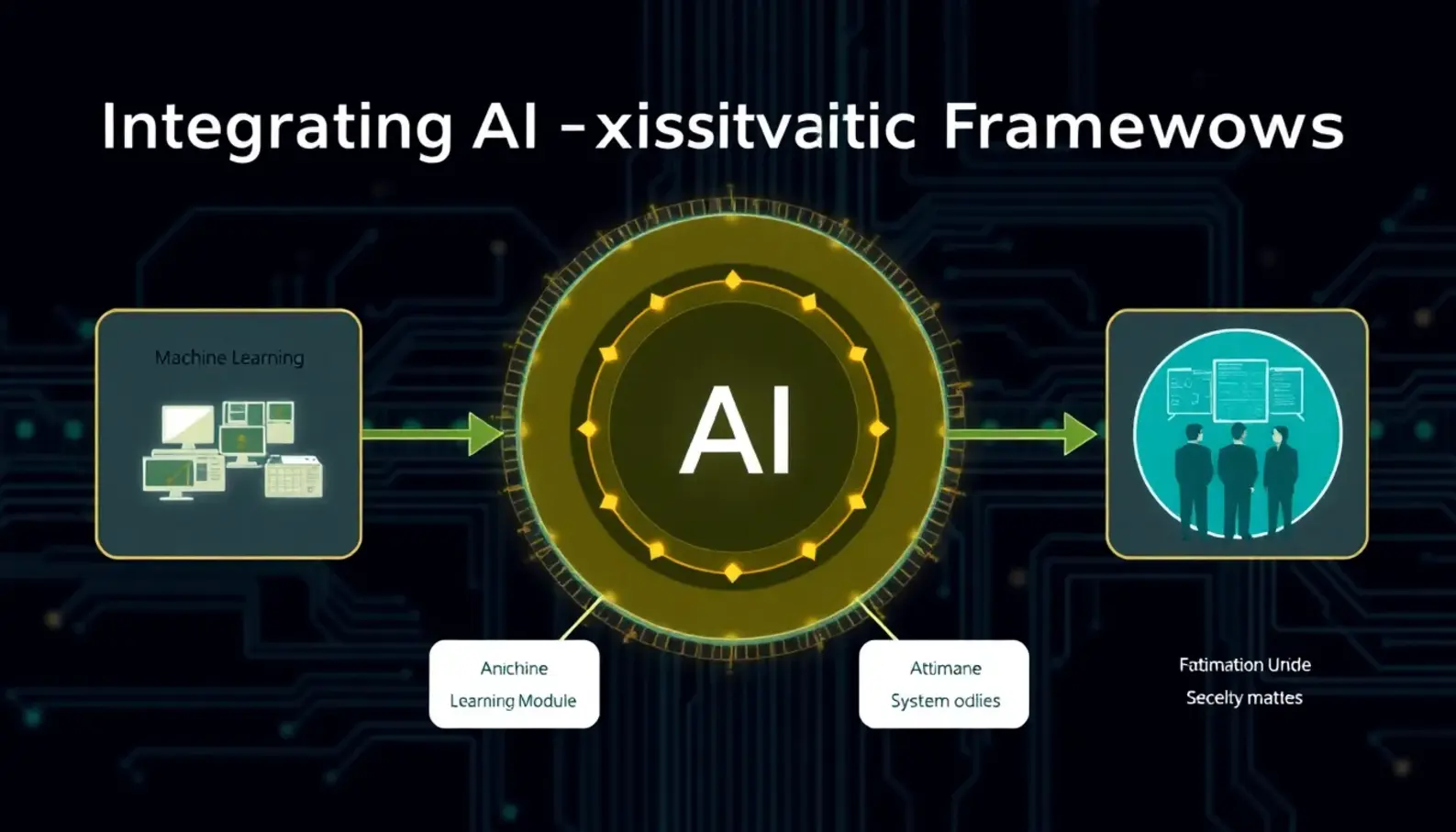
In the realm of cybersecurity, integrating artificial intelligence (AI) into existing security frameworks is increasingly seen as a vital strategy for enhancing defense mechanisms. As digital threats become more sophisticated, the role of machine learning and automation has become central in augmenting the capabilities of traditional security systems. This chapter explores the methodologies and tools available to engineers and clinicians in seamlessly incorporating AI technologies into current cybersecurity infrastructures.
A fundamental approach to integrating AI is through the development of machine learning models capable of real-time threat detection. These models analyze vast volumes of data, identifying deviations from established patterns indicative of potential security breaches. For instance, anomaly detection algorithms can flag unusual user behaviors or network traffic patterns, providing early warnings of cyber threats.
Moreover, AI enhances threat response capabilities by automating routine security tasks. Automated systems can rapidly respond to vulnerabilities, apply patches, and isolate threats before they escalate. This reduces the burden on human operators, allowing them to concentrate on more complex tasks that require unique human insight.
Predictive modeling is another critical area where AI demonstrates significant advantages. By analyzing historical data, predictive models forecast potential security incidents, allowing organizations to proactively mitigate risks. These models continually learn and adapt, refining their predictions and becoming more effective over time.
A case study showcasing a successful integration of AI in cybersecurity involves a healthcare institution that leveraged machine learning to protect sensitive patient data. By deploying an AI-driven security solution, this institution significantly reduced data breaches. The AI model analyzed access logs across various systems, quickly identifying unauthorized access attempts and initiating automated lockdowns.
Similarly, in a financial context, integrating AI into cybersecurity frameworks has resulted in remarkable improvements in fraud detection. Banks have adopted AI algorithms to monitor transactions in real-time. These algorithms successfully identify fraudulent activities by analyzing transaction patterns and alerting security teams, thus minimizing financial loss and safeguarding customer trust.
For engineers, integrating AI necessitates a comprehensive understanding of both AI technologies and the underlying security architecture. They must ensure seamless interoperability between AI-driven solutions and existing security components. This often involves configuring APIs, setting up data pipelines, and ensuring compliance with industry standards and regulations.
Clinicians, although not traditionally involved in IT, have a role to play in ensuring the security of digital health records. Understanding the basics of AI capabilities allows them to collaborate with technical teams effectively. By doing so, they contribute to the secure management of patient data and the swift identification of potential vulnerabilities.
Best practices for integrating AI into security frameworks include conducting thorough risk assessments to identify areas where AI can deliver the most impact. Evaluating tools and technologies that align with organizational objectives is crucial. Security teams should prioritize flexibility and scalability when selecting AI solutions, ensuring they can adapt to future technological advances and increasing threat complexities.
Collaboration and continuous education are essential for maintaining a robust cybersecurity posture. By fostering partnerships between engineers, clinicians, and cybersecurity experts, organizations create an environment that encourages knowledge sharing and innovation. Keeping abreast of the latest AI breakthroughs ensures that security solutions remain effective against emerging threats.
Furthermore, it is important to evaluate ethical considerations when deploying AI in cybersecurity. Discussions around data privacy and algorithmic bias need to be at the forefront of AI integration strategies. Organizations must ensure that AI systems are transparent, fair, and accountable, fostering trust among users and stakeholders.
As AI continues to reshape the cybersecurity landscape, staying informed about its innovations and applications becomes increasingly critical. For further insights into integrating AI across various industries, readers can explore AI in Business Growth, which provides a comprehensive overview of AI applications that drive industry-specific advancements.
In conclusion, integrating AI into existing security frameworks offers a multitude of benefits, enhancing threat detection and response capabilities and providing a proactive approach to cybersecurity. By implementing advanced machine learning and automation solutions, organizations can build resilient systems that withstand the ever-evolving cyber threat landscape.
Final words
AI continues to redefine the landscape of cybersecurity development, equipping engineers and clinicians with powerful tools for threat mitigation. By harnessing these advanced technologies, stakeholders can enhance their security infrastructure, effectively managing risks and responding to threats in real time. Understanding and adopting AI is no longer a luxury but a necessity for a robust cybersecurity posture.
Join our workshop for in-depth insights into AI in Cybersecurity Development.
Learn more: https://innoupdates.com
About us
Our company provides comprehensive workshops and training programs aiming to equip professionals in engineering and clinical roles with the latest tools and methodologies in cybersecurity development utilizing AI. These offerings focus on practical applications of AI technologies, fostering a deep understanding of cybersecurity challenges and strategies.