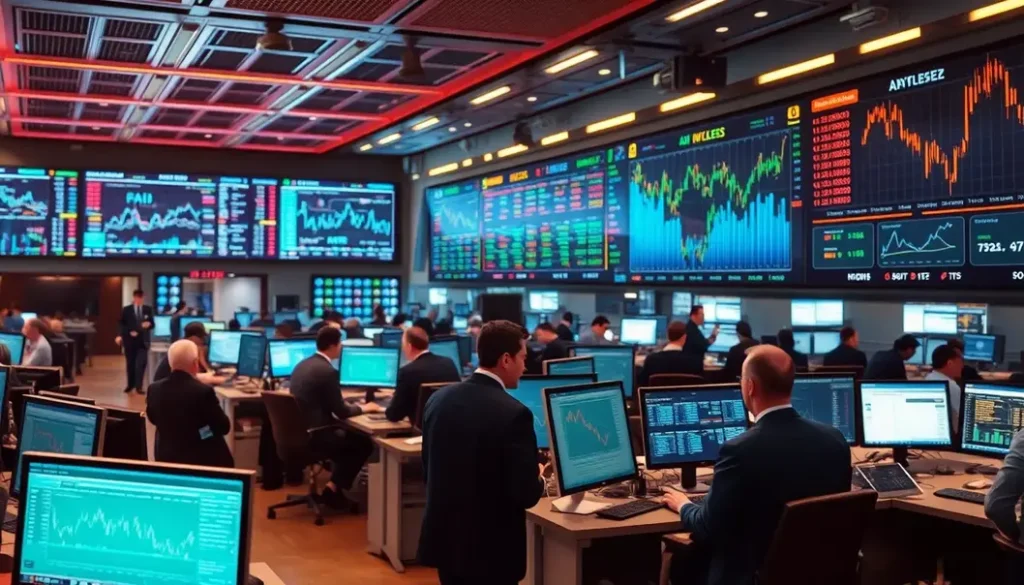
Artificial Intelligence (AI) has begun to reshape financial trading landscapes, providing traders and investment firms with the tools to enhance decision-making processes. By leveraging vast amounts of data and sophisticated algorithms, these technologies enable unprecedented levels of market analysis and strategic execution. Investors can now act upon data-driven insights, improving their ability to forecast market movements and optimize trading strategies, while effectively managing risks. This exploration delves deep into how AI is revolutionizing the world of finance, equipping firms to refine their trading methodologies.
Harnessing Data: The Backbone of AI in Trading

Data is at the heart of artificial intelligence in trading, serving as the essential fuel that powers machine learning engines. The transition from gut-based decisions to data-driven strategies is fundamentally reshaping the financial trading landscape. This chapter delves into how data collection, analysis, and predictive modeling are foundational to AI-driven financial trading strategies.
At the core of these strategies is data itself. The kinds of data harnessed for AI models in trading include historical price movements, trading volumes, economic indicators, and even alternative data sources like sentiment analysis from social media. Each data type holds unique insights. Historical price data helps identify patterns and trends, while trading volumes can suggest market sentiment and potential future movements. Economic indicators provide context on macroeconomic conditions influencing market behavior.
Alternative data is gaining traction as a valuable resource in this domain. Social media sentiment, news headlines, and even satellite images of retailer parking lots can offer unprecedented insights into market dynamics. These data sets allow traders to anticipate market movements before they happen, offering a significant competitive edge.
The processing of these datasets is critical. Raw data is often messy and incomplete, requiring clean-up and standardization. This pre-processing phase is essential to ensure the accuracy and efficacy of predictive models. For example, converting unstructured text data from social media into structured sentiment scores can involve natural language processing techniques and sentiment analysis algorithms.
Once processed, the data is fed into machine learning algorithms which form the crux of AI-driven trading. Algorithms such as neural networks, decision trees, and support vector machines are employed to glean patterns and predict future market trends. Neural networks, in particular, are adept at handling complex data relationships, making them ideal for predicting stock prices. Reinforcement learning, another potent method, allows algorithms to learn and adapt trading strategies over time by maximizing rewards based on historical successes.
The role of machine learning in this context cannot be understated. Machine learning allows for the construction of models that can predict asset price movements even in volatile markets. These models are continuously refined based on new data, adapting and learning from each trade executed. However, the success of these models hinges on the integrity of the data they are trained on.
Data integrity is crucial for generating reliable insights. Poor data quality can lead to inaccurate predictions, resulting in financial losses. Therefore, maintaining data accuracy, consistency, and cleanliness is paramount in AI-driven trading. Financial data is prone to anomalies due to errant inputs or system errors, necessitating robust validation mechanisms.
Integrating AI into traditional trading frameworks does present significant challenges. Legacy systems often lack the flexibility to incorporate real-time data feeds necessary for AI models. Moreover, the computational complexity of running AI models can be prohibitive without modern infrastructure. The integration process must also address compliance and regulatory risks, as AI models need to operate within the legal frameworks governing financial markets.
Despite these challenges, AI-driven strategies are rapidly advancing, carving out more efficient, data-driven paths in trading. With continued enhancements in data processing technologies and machine learning algorithms, AI is eliminating traditional barriers, allowing for more nuanced and accurate trading strategies. For further insights into how AI is revolutionizing financial markets, you may explore AI in Finance Strategies.
Ultimately, the complexity and success of AI in trading rest significantly on the quality and handling of data. As technology advances, the ability to harness vast amounts of data with increasing speed and accuracy positions AI as a transformative force in financial trading.
AI Strategies: Intelligent Trading Tactics in Action

Artificial intelligence has transformed financial markets by introducing complex strategies powered by advanced algorithms. This transformation allows firms to execute trades with unprecedented speed and accuracy. AI-driven trading strategies such as algorithmic trading systems, high-frequency trading, and sentiment analysis are reshaping the financial landscape.
Algorithmic trading is the cornerstone of AI in the financial sector. These systems use predefined sets of rules to automate trading decisions, allowing traders to conduct transactions at speeds impossible for human counterparts. By analyzing historical data, algorithmic systems can optimize strategies to meet specific investment goals. They operate on principles of efficiency, utilizing machine learning techniques to adapt to market conditions dynamically.
High-frequency trading, or HFT, employs algorithms that execute numerous trades within microseconds. This approach leverages the minimal latency of modernized trading infrastructures to capitalize on fleeting market inefficiencies. HFT strategies rely on statistical arbitrage, exploiting price discrepancies between markets. AI enhances these strategies by optimizing execution processes, reducing transaction costs, and minimizing slippage.
Sentiment analysis is another powerful AI-driven strategy gaining traction. By analyzing public sentiment from social media, news articles, and other sources, AI systems gauge market sentiment and predict potential price movements. Natural language processing (NLP) techniques play a pivotal role here, sifting through vast amounts of unstructured data to extract insights and inform trading decisions.
Reinforcement learning (RL) has become a vital part of developing and optimizing trading strategies. RL algorithms learn to make decisions by receiving feedback from their trading environment, essentially mimicking human learning processes. The continuous adaptation to new data empowers RL-driven systems to outperform traditional strategies over time. Traders can deploy these systems to handle various assets, from equities to derivatives, enhancing diversification and risk management.
Neural networks also contribute significantly to strategy development. These intricate models resemble human brain architecture, processing complex datasets to uncover patterns not immediately apparent. Deep learning, a subset of neural networks, is particularly adept at identifying nonlinear relationships in data. By leveraging such models, traders gain strategic advantages by detecting hidden market dynamics.
Several success stories illustrate how firms have integrated AI into their trading operations. One notable example is a hedge fund that utilized AI to achieve significant gains by rebalancing portfolios based on real-time market analysis. By identifying inefficiencies across multiple asset classes, the firm enhanced returns while mitigating risk. Another success story involves a proprietary trading firm that developed an AI system to predict short-term market trends. The system outperformed traditional quantitative models, showcasing AI’s potential to revolutionize trading.
Leading firms are not only integrating AI in strategy optimization but are also focusing on developing hybrid models that combine human intuition with AI precision. This synergy enables firms to harness the best of both worlds — machine efficiency augmented by human oversight reduces the risk of algorithmic biases.
For firms looking to adopt AI in their trading operations, a robust framework for implementation is essential. This includes setting up IT infrastructure equipped to handle big data and real-time analytics. Moreover, ensuring compliance with regulatory standards and implementing stringent risk management systems are critical for sustainable AI adoption.
As AI continues to evolve, it promises to further redefine financial trading. Its integration into existing systems enhances strategic decision-making, boosts efficiency, and paves the way for innovation in trading practices. Financial institutions that embrace AI will likely maintain a competitive edge in an ever-evolving market landscape.
For further insights into AI’s role in optimizing business strategy, explore AI in Business Growth.
Final words
The integration of AI into financial trading is not merely a trend but an essential evolution in investment strategies. By embracing data-driven insights, traders and investment firms can significantly enhance their market analysis and decision-making processes. As technology continues to advance, understanding and leveraging AI tools will become crucial for staying competitive in the dynamic financial landscape.
Master Financial Trading with AI
Learn more: https://innoupdates.com
About us
Our expertise lies in delivering advanced AI solutions for algorithmic trading and market analysis, empowering firms to harness the power of data for strategic investment success.