
Artificial Intelligence (AI) is reshaping supply chain operations, offering businesses new avenues for efficiency, transparency, and responsiveness. By analyzing vast datasets and predicting trends, AI empowers stakeholders to streamline processes, enhance decision-making, and reduce costs. From demand forecasting to inventory management, AI-driven tools are essential for navigating complex supply chain dynamics. Developers and leaders can leverage these technologies to automate routine tasks, extract valuable insights, and foster innovation. This exploration delves into the practical applications of AI in supply chain operations, offering developers insights for implementation and leaders guidance for strategic integration.
Predictive Analytics: Enhancing Decision-Making in Supply Chains

Predictive analytics is becoming an integral feature of modern supply chain management. By utilizing sophisticated AI algorithms, businesses can delve deep into data analysis techniques such as machine learning and statistical models. These methodologies provide critical insights that enhance decision-making processes, making predictions about market demands, disruptions, and opportunities more accurate and timely.
Machine learning models enable supply chains to learn from historical data and predict future patterns. These models can be trained on vast datasets, identifying complex patterns often unnoticed by human analysts. Statistical models, on the other hand, offer a different approach by using historical relationships among variables to project future outcomes. By harnessing these methodologies, companies not only improve operational efficiency but also address challenges in real-time.
Consider a multinational retailer dealing with inventory management. Utilizing predictive analytics allows the company to forecast demand with remarkable accuracy. As a result, the retailer can adjust its stock levels, minimizing waste and avoiding stockouts. With these analytics, the company dynamically adjusts inventory levels based on predicted customer demand, maximizing storage efficiency and reducing holding costs.
Moreover, predictive analytics augments demand forecasting capabilities. By analyzing consumer behavior and external data such as market trends and economic indicators, companies can anticipate shifts in demand. This foresight enables supply chain managers to adapt production schedules and logistics plans proactively, ensuring resource optimization and customer satisfaction.
In another case study, a logistics company harnesses AI-powered predictive analytics to optimize its transportation routes. Through analysis of historical traffic patterns, weather forecasts, and real-time data, the system suggests optimal routes that minimize delivery times and fuel consumption. The outcome is a significant reduction in operational costs and enhanced service reliability, directly benefiting the company’s bottom line.
For developers seeking to integrate predictive analytics into existing systems, several practical considerations arise. First, establishing a robust data infrastructure is essential. Consistent data collection and real-time data access enable predictive models to function effectively. Additionally, integrating machine learning platforms with current software ecosystems can enhance data processing capabilities.
Data privacy also demands stringent consideration. Implementing secure data governance frameworks ensures compliance with legal standards while protecting sensitive customer and corporate information. Developers should consider collaboration with data scientists to refine model accuracy and performance. Understanding domain-specific nuances further fine-tunes the analytics, aligning it with organizational objectives.
For leaders, the strategic application of insights gained from predictive analytics is paramount. Aligning predictive outcomes with business strategies enhances decision-making at all organizational levels. This alignment ensures that operational strategies are flexible, responsive, and informed by data-driven insights. Moreover, by embedding predictive analytics within strategic planning frameworks, leaders can craft more resilient and adaptable supply chains. Such integration fosters a culture of innovation, where data empowers every decision-maker to drive the business towards achieving competitive advantages.
Thus, predictive analytics serves as a transformative force within supply chain operations. By reshaping forecasting and decision-making, it enables companies to anticipate market dynamics more effectively. As businesses continue to navigate a complex and interconnected global landscape, harnessing AI-powered tools becomes an imperative for sustainable growth and operational excellence. For more insights on AI applications in various industries, explore our article on AI in Business Growth.
Automation and Robotics: Streamlining Supply Chain Operations
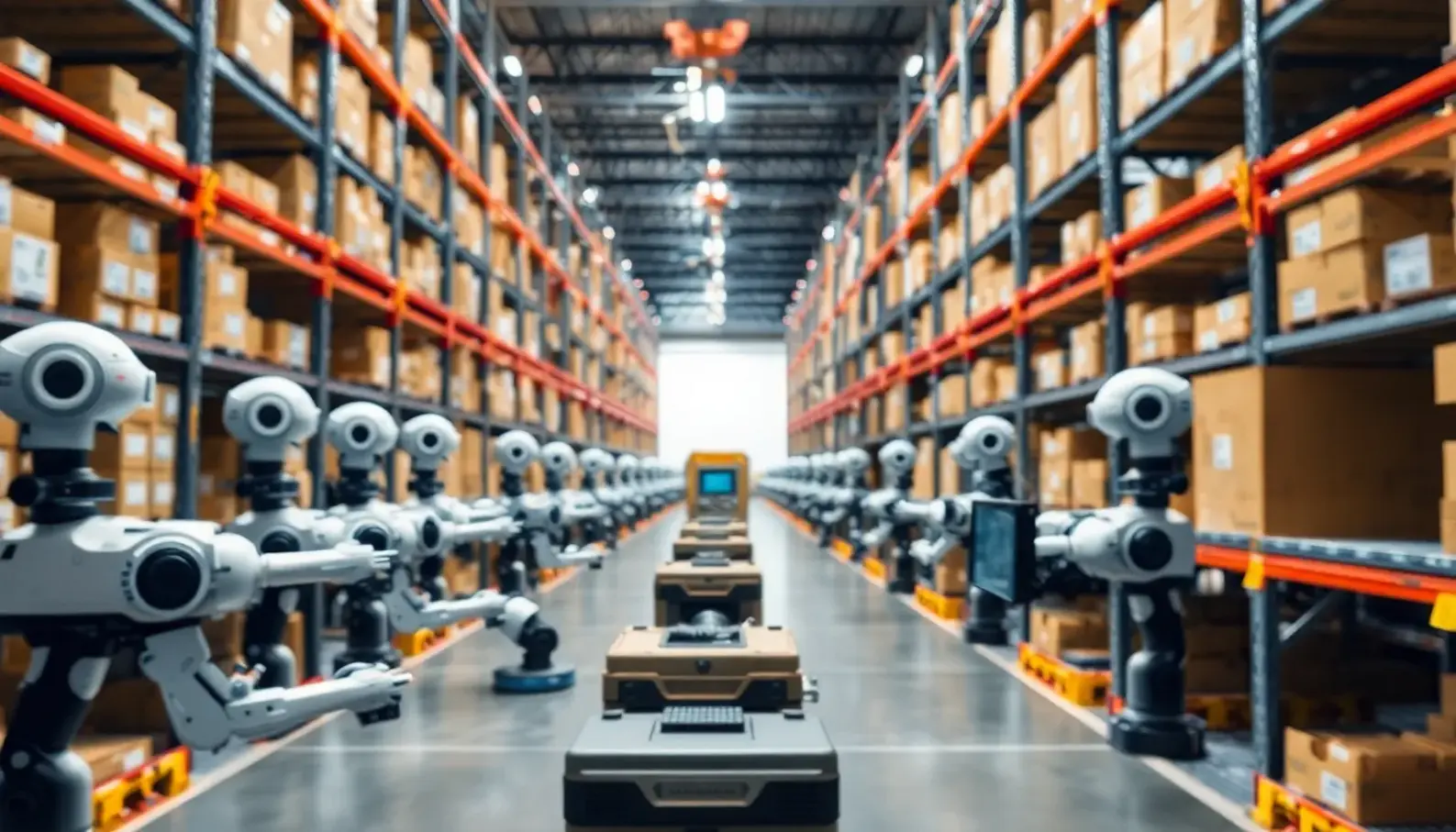
Automation and robotics have emerged as pivotal elements in optimizing supply chain operations, significantly enhancing efficiency by automating a myriad of tasks. AI-powered robots have the capability to revolutionize tasks ranging from warehousing to logistics, drastically reducing manual errors and operational costs. They not only speed up processes but also improve accuracy, reducing the dependency on human intervention and the potential for error.
In the context of warehousing, robots equipped with sophisticated sensors and AI algorithms can sort, pack, and transport goods with precision. These tasks, traditionally labor-intensive, can now be performed rapidly and with minimal error. Moreover, robots can work uninterrupted, enhancing productivity and allowing round-the-clock operations. Logistics also benefit, with autonomous vehicles and drones optimizing delivery routes and schedules, further reducing costs and ensuring timely deliveries.
A significant consideration in this transformation is the integration of robotic process automation (RPA) with existing supply chain software. Compatibility is critical, allowing seamless communication between various components of the supply chain. Scalability further ensures that as businesses grow, the integration remains effective and the systems continue to operate efficiently. This integration demands meticulous planning to align new technologies with existing IT infrastructures without disrupting operations.
For developers, building automation scripts requires a deep understanding of both the technological infrastructure and the strategic objectives of the organization. Automation scripts must be adaptable, allowing for modifications as new technologies and challenges arise. Collaboration between IT departments and supply chain managers is crucial to ensuring that automation meets the operational demands and strategic goals of the organization effectively.
For business leaders, evaluating the return on investment (ROI) in robotics is paramount. Investments should align with broader strategic objectives, focusing on long-term benefits rather than short-term gains. Key performance indicators (KPIs) must be defined clearly to measure success, including reductions in lead times, improvements in accuracy, and overall cost savings. Leaders need to be proactive in assessing the potential risks and rewards associated with the implementation of robotic solutions.
Another critical factor is the ongoing management and maintenance of robotic systems. As with any technology, regular updates and troubleshooting are necessary, requiring skilled personnel to manage these tasks. Training staff to understand and work with these technologies is integral to fostering a collaborative environment where human workers and robots complement each other, maximizing efficiency and innovation within the supply chain.
Strategically, businesses must also consider the implications of big data. Robots generate vast amounts of data that, when analyzed properly, can provide insights into operational efficiencies and areas for improvement. Coupled with AI, this data can lead to predictive analytics, enabling supply chain managers to anticipate and mitigate potential disruptions.
Furthermore, as industries continue to digitize, constant innovation in the field of robotics ensures that supply chains remain flexible and adaptable. Emerging technologies such as autonomous drones in logistics are reshaping the way goods are delivered, with implications for the speed and efficiency of supply chains. Such innovations are pivotal in maintaining a competitive edge in an increasingly demanding market landscape.
In conclusion, the role of automation and robotics in supply chain operations promises a future where efficiency and innovation go hand in hand. By focusing on strategic integration and continuing to invest in new technologies, businesses can achieve unparalleled efficiencies and stay ahead in the dynamic world of global supply chains.
Final words
AI’s integration into supply chain operations is accelerating efficiencies and redefining industry standards. By leveraging predictive analytics and automation, businesses can optimize their processes and respond adeptly to market demands. The collaboration between developers and leaders is crucial for successfully harnessing these technologies, ensuring that supply chains become more agile and resilient. As organizations continue to innovate, investing in AI capabilities will be key to maintaining a competitive edge.
Download E-Book
Learn more: innoupdates.com
About us
Our company specializes in providing cutting-edge AI solutions tailored for supply chain management. We offer a range of services, including predictive analytics, inventory optimization solutions, and robotic process automation systems, all designed to enhance operational efficiency and drive data-driven decision-making in your organization.