The confluence of artificial intelligence and quantum computing heralds a new era of computational prowess. Quantum algorithms, leveraging superposition and entanglement, promise exponential speed-ups over classical approaches. This emerging synergy is paving the way for sophisticated AI models while solving complex problems previously deemed intractable. Quantum physicists and computer scientists alike stand at the vanguard of this technological revolution, poised to redefine what is computationally feasible.
Harnessing Quantum Mechanics: A Paradigm Shift for AI
Quantum mechanics introduces a fascinating lens through which to view computation, distinctly departing from classical paradigms. The foundational principles of quantum systems—such as superposition, entanglement, and quantum gates—form new potentials to reimagine the functional ambit of Artificial Intelligence (AI).
Superposition lies at the heart of quantum mechanics. Unlike classical bits, which exist in a state of 0 or 1, quantum bits, or qubits, harness superposition to exist simultaneously in multiple states. This capability allows for a dramatic increase in computational power, enabling quantum systems to explore a multitude of possibilities in parallel. In AI applications, this could significantly enhance tasks such as machine learning. By evaluating various hypotheses in parallel, quantum-based models can accelerate the search for optimal solutions, effectively refining training processes over dualistic classical computations.
Entanglement, another quantum property, plays a crucial role in extending the power of quantum systems. When qubits become entangled, the state of one qubit instantly influences the state of another, regardless of the distance separating them. This spooky interaction, as Einstein famously referred to it, allows for the creation of intricate models that can handle dependencies and correlations traditionally challenging for classical systems. In practical AI applications, entangled qubits can improve the efficiency of neural networks and enhance robustness in complex pattern recognition tasks.
Quantum gates are operations applied to qubits, analogous to logical gates in classical computing. However, quantum gates manipulate qubits through rotations in a Bloch sphere, enabling more complex behavior than their classical counterparts. These gates form the building blocks of quantum circuits, paving the way for novel AI algorithms. By simulating processes beyond conventional brute force methods, quantum circuits resolve problems intractable on classical computers. Optimizing these circuits grants AI systems unprecedented efficiency in processing and analyzing vast datasets, crucial in areas like big data and real-time analytics.
Quantum parallelism is the emerging frontier propelling AI into new realms of discovery. By conducting many calculations simultaneously, quantum computers offer a profound boost to AI systems that must navigate large solution spaces. This capability directly impacts optimization challenges, a core component of many AI algorithms. For instance, in logistic planning or resource allocation, quantum-enhanced AI can determine near-optimal solutions far more swiftly than traditional methods.
The theoretical prowess of quantum mechanics supports not only a conceptual overhaul but provides tangible, practical advances across AI disciplines. In machine learning, quantum-enhanced techniques lead to the development of quantum neural networks. These networks, utilizing qubits and quantum gates, can process information with a higher degree of complexity and in less time compared to classical models. The symbiotic relationship between quantum mechanics and AI could redefine supervised learning by reducing training times and improving model accuracy.
Moreover, in data analysis, quantum mechanics allows the construction of quantum algorithms that sort, search, and classify data more proficiently. Quantum computers can dramatically speed up databases searching through algorithms like Grover’s algorithm. For AI, this means real-time insights into data trends and the ability to generate new patterns of visibility in enormous datasets.
While these prospects are promising, implementing such quantum-enhanced AI systems is not without its share of challenges. Developing error-correcting codes, combating decoherence, and creating scalable quantum processors remain areas of active research and development. Yet, the potential fruits of these efforts are vast. As AI intertwines with quantum computing, it positions itself as the catalyst for breakthroughs in fields ranging from healthcare to finance, as highlighted in our overview of quantum innovations in computational strategies.
In harnessing the principles outlined, AI systems stand to benefit greatly from the synergy brought forth by quantum mechanics. More efficient computational pathways, novel pattern recognition capabilities, and faster problem-solving techniques loom on the horizon, painting a picture of a future where the union of quantum mechanics and AI unlocks entirely new dimensions of technological innovation. Continuous exploration and collaboration in this space promise breakthroughs not only in computing but across global industries and the collective understanding of intelligence itself.
Quantum Algorithms: Accelerating Machine Learning Frontiers
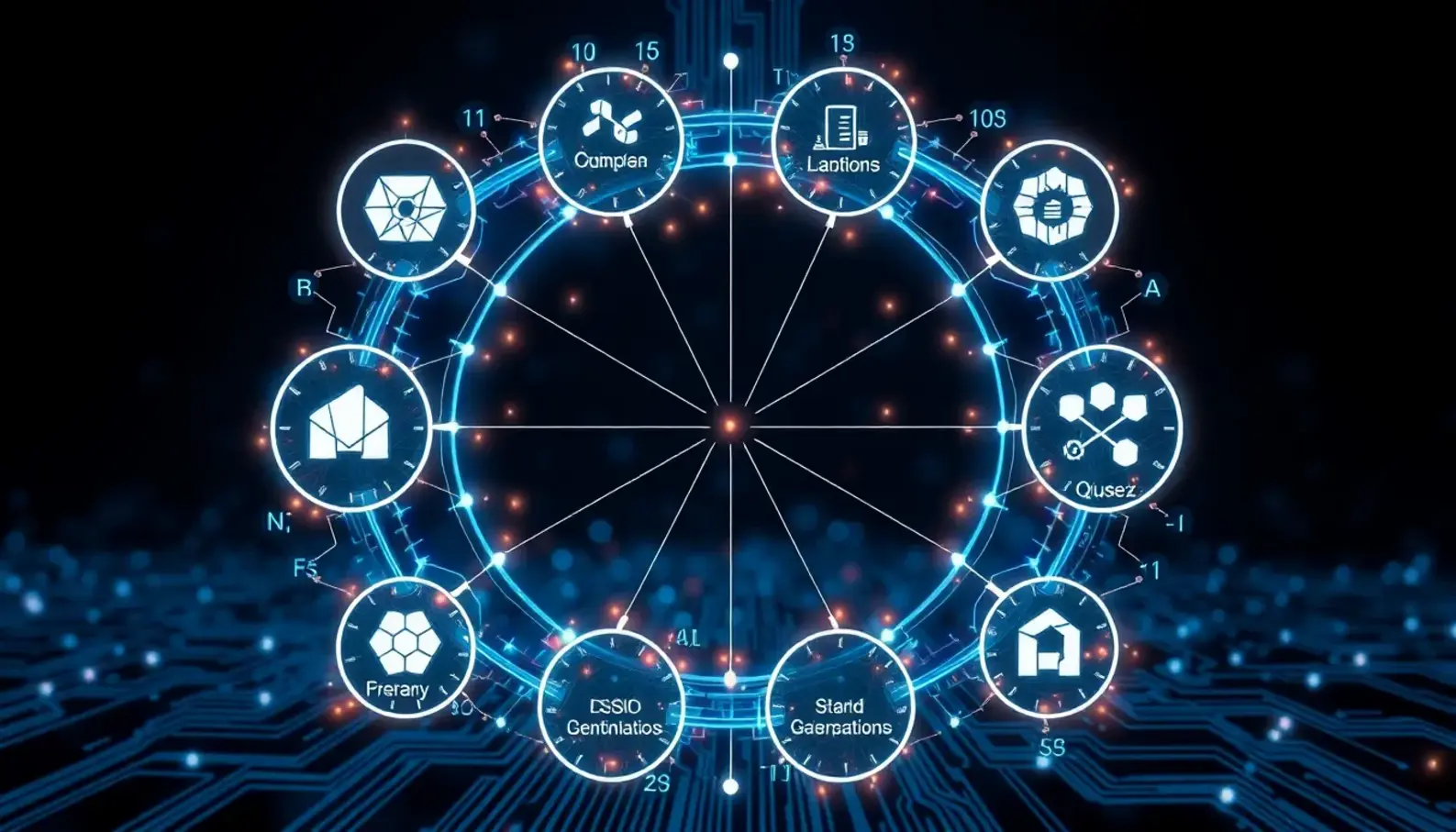
The intersection of quantum computing and artificial intelligence is igniting revolutionary possibilities in machine learning. At the core of this synergy are quantum algorithms designed to transcend the limitations of classical computing. Among the most transformative of these algorithms are Grover’s search algorithm and the Quantum Approximate Optimization Algorithm (QAOA), both of which offer profound enhancements in computational speed and efficiency.
Grover’s search algorithm is a paradigmatic example of the advantages quantum computing brings to machine learning. It notably accelerates search problems, achieving a quadratic speedup over its classical counterparts. In classical computing, a search through unsorted data takes linear time—i.e., for ‘n’ items, you need ‘n’ checks on average. Grover’s algorithm reduces this to the square root of ‘n’, making it incredibly powerful for database searches and certain optimization problems. However, its applicability extends beyond mere data retrieval. In machine learning, where optimization problems are rampant, Grover’s algorithm can play a pivotal role in training models by optimizing parameters more efficiently.
The utility of Grover’s algorithm in the realm of machine learning is further underscored in hyperparameter tuning and feature selection. These processes typically demand significant computational resources due to the vast search space. By employing a quantum-assisted approach, Grover’s algorithm can dramatically streamline these efforts, identifying optimal configurations at unprecedented speeds. This capability hints at not just acceleration but also an elevation in the quality of models produced, as more configurations can be explored within the same timeframe.
Meanwhile, the Quantum Approximate Optimization Algorithm (QAOA) is making waves with its ability to address complex combinatorial optimization problems. QAOA’s design specifically targets problems that are NP-hard, where classical algorithms struggle to find efficient solutions. This is particularly relevant in machine learning applications involving large-scale data clustering, where partitioning a data set into coherent groups is computationally intensive. QAOA’s potential to handle such tasks with greater efficiency can redefine how machine learning models classify and interpret data, leading to innovations in areas from natural language processing to image recognition.
QAOA operates by leveraging both quantum and classical resources to produce high-quality solutions for optimization problems. This hybrid approach acts as a bridge in the current era, where fully-fledged quantum computers are not yet universally accessible. By retaining a component of classical processing, QAOA ensures that it can be implemented on near-term quantum devices, thus catalyzing immediate breakthroughs in machine learning tasks that were previously deemed intractable.
The implications of these quantum algorithms extend across various real-world applications. In natural language processing (NLP), for instance, factors such as language ambiguity and context understanding present significant challenges. By utilizing quantum-enhanced algorithms, NLP systems can potentially parse vast language datasets more swiftly, improving translation accuracy and contextual comprehension. Moreover, in simulations that require rendering highly intricate systems—such as climate models or molecular biology—quantum algorithms could optimize the computational requirements, enabling more precise and nuanced simulation outcomes.
The intertwining of quantum computing and AI also prompts considerations about the development of robust AI architectures. As quantum algorithms continue to evolve, AI frameworks must adapt to incorporate quantum principles. This evolution will likely manifest in the formation of new algorithmic paradigms that blend classical and quantum computational principles, offering new methods of approaching AI problems.
One promising future direction is the exploration of neuromorphic computing, which draws inspiration from the neural structure of the human brain. Here, quantum algorithms could play a vital role in simulating neural networks more efficiently, contributing to the advancement of AI architectures that are more akin to organic intelligence. Through quantum computing’s unique capabilities, the aspiration to achieve more robust and flexible AI systems draws closer.
In conclusion, quantum algorithms like Grover’s and QAOA mark a crucial step forward in addressing the computational challenges posed by machine learning tasks. By substantially improving speed, enhancing optimization techniques, and facilitating better pattern recognition, these algorithms are transforming the landscape. As quantum computing technology progresses and becomes more accessible, it holds the potential to reinvigorate AI development, solving some of the most stubborn challenges in machine learning. For a deeper exploration of how hybrid computing strategies aid in bridging the gap between AI and quantum computing, refer to this resource.
Final words
The integration of AI with quantum computing represents a frontier brimming with possibilities. As quantum technologies advance, they will not only augment AI capabilities but also revolutionize industries by addressing complex challenges. Pioneering researchers now have the opportunity to lead in this interdisciplinary arena where physics intertwines with computational intelligence, shaping the future of innovative applications.
Explore the Potential of Quantum AI
Learn more: innoupdates.com
About us
Quantum Computing AI Research and Development focuses on bridging the gap between artificial intelligence and quantum computing, providing cutting-edge solutions to tackle complex problems across various industries.