
AI has emerged as a powerful tool in healthcare analytics, reshaping how data is leveraged to enhance clinical practices, operational efficiency, and patient outcomes. The integration of AI technologies enables researchers and clinicians to harness vast amounts of data for deeper insights into patient health and disease progression. With a range of applications from predictive analytics to personalized medicine, the potential for improved decision-making is significant. However, developing an AI-driven healthcare analytics strategy requires careful consideration of data quality, ethical concerns, and interoperability. This article delves into the intricate components of building a robust AI analytics framework within the healthcare sector.
Understanding the Landscape of AI in Healthcare Analytics

Artificial Intelligence (AI) in healthcare analytics is revolutionizing how data is harnessed to reshape patient care and enhance clinical decision-making. AI technologies, integrated into various healthcare domains, are playing pivotal roles in areas such as predictive analytics, natural language processing (NLP), and machine learning (ML). These innovations are transforming not only operational efficiencies but also the quality of patient outcomes.
One of the most impactful applications of AI is predictive analytics. By analyzing vast amounts of patient data, including electronic health records (EHRs) and medical imaging, AI can predict health risks and disease progression with increasing accuracy. Predictive models, driven by advanced algorithms, deliver insights that enable healthcare providers to intervene earlier and customize treatment plans. For example, predictive analytics can forecast which patients are at risk of developing complications post-surgery, allowing for tailored preoperative and postoperative care regimens.
Natural language processing is another cornerstone of AI in healthcare analytics. NLP leverages unstructured data within EHRs, extracting valuable insights from physician notes, patient histories, and medical literature. This capability improves clinical documentation, enhances the accuracy of patient records, and aids in the discovery of potential drug interactions. Moreover, NLP systems can support the administrative side of healthcare by streamlining billing and coding processes, thus reducing human error and administrative burden.
Machine learning algorithms are also being deployed extensively across healthcare systems. ML models can learn and adapt from collective patient data, aiding in pattern recognition and anomaly detection. Such capabilities are essential in diagnosing rare diseases or recognizing fluctuations in patient health that standard protocols might not detect. For instance, in oncology, ML algorithms are utilized to personalize cancer treatment plans by identifying specific genetic markers indicative of how a patient might respond to therapy.
Several case studies exemplify successful AI integration into healthcare analytics. One notable case is the use of AI in imaging diagnostics. In radiology, AI systems assist radiologists by highlighting potential areas of concern within scans, significantly speeding up the review process. AI algorithms in cardiology have demonstrated proficiency comparable to seasoned cardiologists in detecting arrhythmias via ECGs. These implementations showcase the practical benefits of AI in enhancing diagnostic precision and reducing cognitive fatigue among clinicians.
A discussion about AI in healthcare would be incomplete without considering the importance of data sources. EHRs serve as a foundational dataset for many AI models, offering comprehensive patient information that can drive insights into patient management and outcomes. Medical imaging data, from MRI to CT scans, is indispensable, providing rich sources of visual data that AI can analyze beyond human capability. Genomic data adds another layer, allowing AI systems to delve into personalized medicine approaches tailored to an individual’s genetic profile.
While AI offers immense opportunities, it also brings forth challenges that demand careful consideration. Data privacy is paramount, given the sensitive nature of healthcare information. Ensuring compliance with regulations such as HIPAA in the U.S. or GDPR in Europe is crucial. Encryption, anonymization, and secure data-sharing protocols are strategies to mitigate privacy concerns.
Bias in AI algorithms is another challenge. Bias arises from unrepresentative data, which can lead to inequitable treatment recommendations or misdiagnosis across diverse patient populations. Developers must ensure diverse and comprehensive datasets are used during the training phase.
Interoperability remains a significant hurdle in harnessing AI’s full potential in healthcare analytics. Integrating AI systems across heterogeneous EHR systems and platforms is essential for seamless operation. Efforts to standardize healthcare data formats and promote open APIs are steps in the right direction to overcoming these barriers.
Further insights into the role of AI in healthcare and other domains can be explored here, where the convergence of AI and wearable technology in health monitoring is discussed, highlighting the innovative strides in patient care and analytics.
In summary, understanding the landscape of AI in healthcare analytics is key to realizing its potential. Predictive analytics, NLP, and ML are at the forefront, driving innovations that transform patient care and clinical decisions. While significant challenges exist, proactive strategies can mitigate risks, paving the way for AI’s successful integration into healthcare.
Building an AI-Driven Healthcare Analytics Strategy
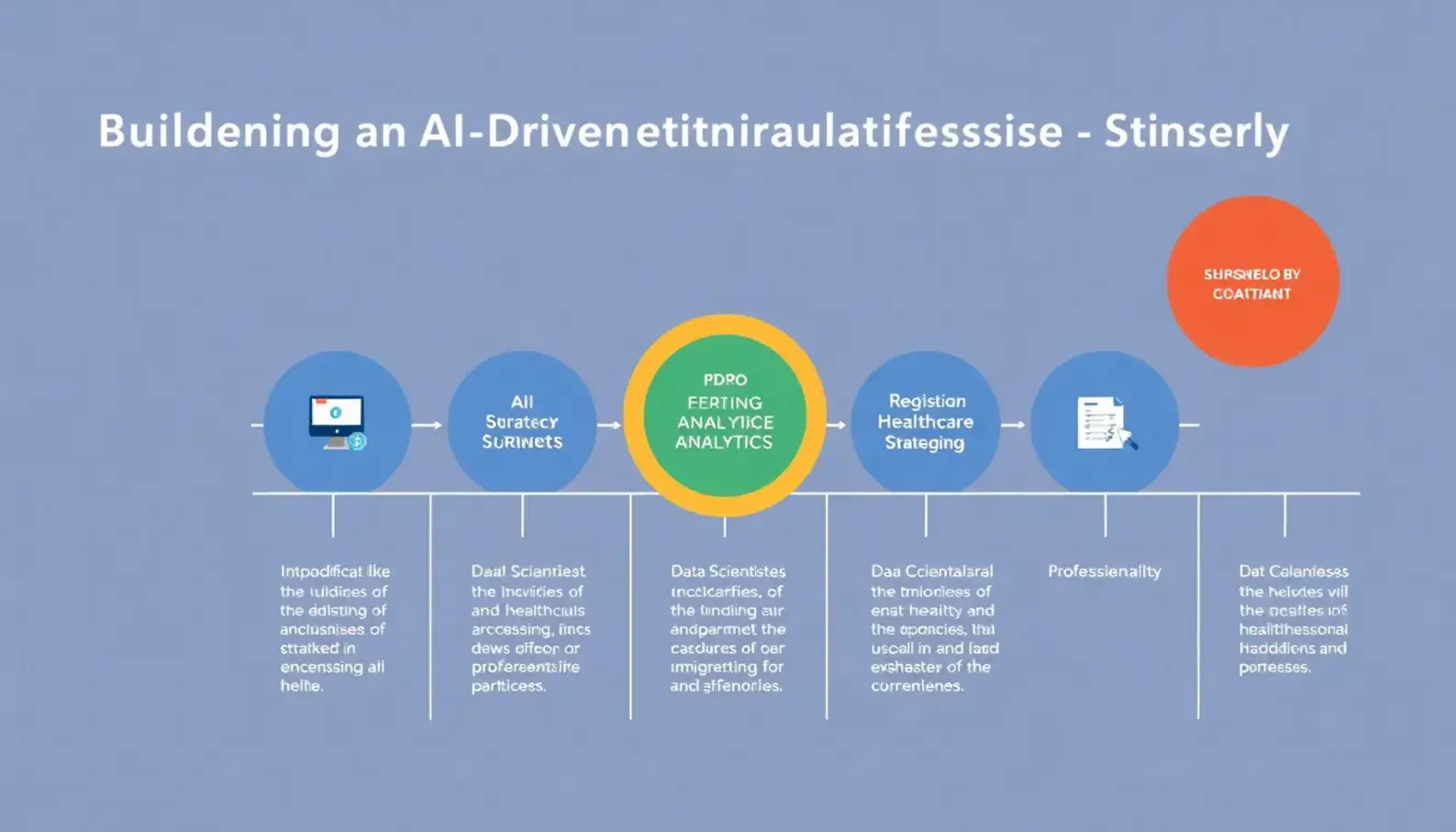
Integrating AI into healthcare analytics requires a strategic approach, balancing technological resources with organizational capabilities. Effective data collection, integration, and quality assurance form the backbone of a successful AI deployment in healthcare.
The first step is meticulous data collection. Accurate and comprehensive data lays the foundation for insightful analytics. Healthcare institutions must ensure that data is collected from diverse sources, including electronic health records, patient feedback, and connected devices. Each data point adds to a robust dataset that AI models can learn from.
Integration is the next crucial phase. Cross-platform data exchange systems must be implemented to consolidate data from disparate systems. These systems allow seamless flow and accessibility, ensuring that AI tools can analyze uniform datasets. Care must be taken to manage the heterogeneity of data formats and sources, opting for standardized data exchange protocols where feasible.
Maintaining high data quality is non-negotiable. Poor data quality can lead to incorrect analytics and flawed AI insights. Regular audits of data inputs, addressing missing or inconsistent records, and employing pre-processing algorithms are essential. These processes help verify the integrity and validity of the data, ensuring the AI models output reliable information.
Security is another cornerstone of AI-driven healthcare analytics. Protecting patient data from breaches and unauthorized access is critical. Healthcare providers must employ robust encryption methods and access control measures. Privacy frameworks, compliant with standards such as GDPR, help safeguard patient information, maintaining trust in technological innovations.
Selecting the appropriate AI tools and technologies is pivotal. This selection should align with the organization’s objectives and current technological infrastructure. Decision-makers must evaluate AI platforms based on criteria such as usability, scalability, and support for integration with existing systems. As AI continues to evolve, leveraging flexible and adaptable tools becomes increasingly advantageous to accommodate future developments.
Multidisciplinary collaboration is fundamental to the strategic integration of AI in healthcare. Cooperation among healthcare professionals, data scientists, and IT experts is key to bridging the gap between clinical insights and technical expertise. This collaboration fosters a deeper understanding of healthcare processes, enabling the design of AI systems that address real-world clinical challenges.
Education and training are indispensable elements. Continuous professional development ensures that all stakeholders remain informed about AI capabilities and its practical applications within healthcare. Structured training programs can increase proficiency in AI tools and methods, empowering staff to implement and utilize AI solutions effectively.
Ethical considerations necessitate constant attention when deploying AI in healthcare. Algorithms should be designed with fairness and equity in mind, actively addressing biases that could affect patient outcomes. Transparent decision-making processes, coupled with accountability frameworks, are essential to ensure ethical AI practices. These measures help build trust in AI systems, facilitating their broader acceptance and integration.
In summary, developing an AI-driven healthcare analytics strategy involves a comprehensive framework focusing on data management, technology selection, and human factors. This approach, underpinned by cross-disciplinary collaborations and ethical vigilance, can lead to significant improvements in patient outcomes. For more insights on the impact of emerging technologies in healthcare, you can explore this article on AI wearable tech in health.
Final words
The integration of artificial intelligence into healthcare analytics offers a path toward enhanced patient outcomes and optimized clinical decision-making. By understanding the landscape of AI applications and establishing effective strategies, clinicians and researchers can leverage data in powerful ways. Emphasizing collaboration, data integrity, and ethical considerations is essential for creating a sustainable and impactful AI-driven healthcare framework.
Try Free Demo
Learn more: https://innoupdates.com
About us
Our company provides innovative AI-driven solutions designed to enhance healthcare analytics. We focus on integrating advanced technologies with clinical workflows to ensure data-driven decision-making that improves patient care and operational efficiency. By offering tailored services and tools, we help healthcare organizations realize the full potential of their data assets, facilitating improved outcomes and enhanced research capabilities.